
The World's New Trade Map
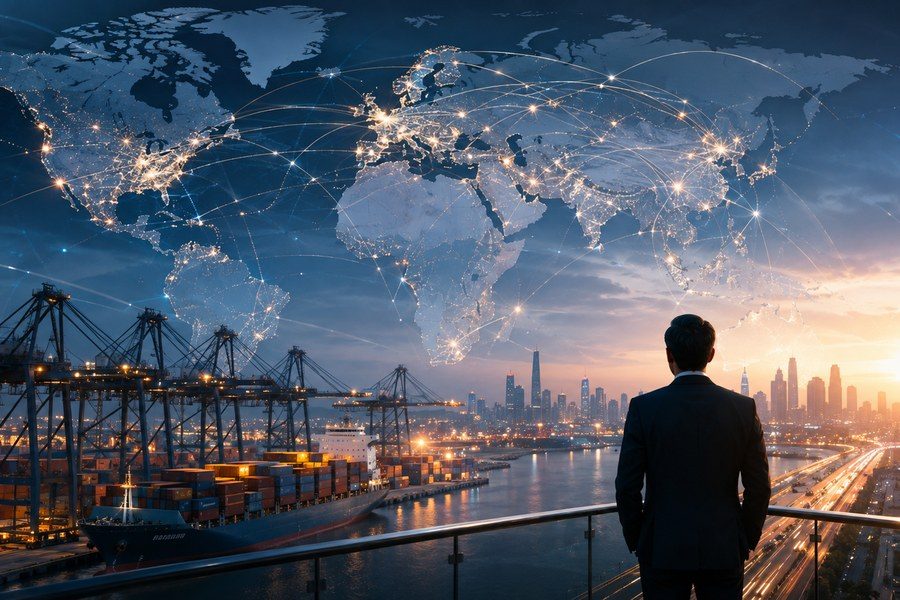
Globalization has not ended — it has changed shape. Political alliances increasingly determine commercial relationships, infrastructure has become a strategic asset rather than a background utility, and supply chains are now designed around resilience and access rather than cost alone. The map still exists. Many of its routes do not.
There was a time when global trade looked almost mechanical. Manufacturing migrated to wherever labour was cheaper, goods crossed oceans through predictable shipping lanes, and companies measured success by efficiency, scale and cost. That world has not disappeared — it has simply become harder to recognize.
The most important change in international trade is not that globalization is ending. It is that globalization is changing shape. Political alliances increasingly determine commercial relationships. Infrastructure has become a strategic asset rather than a background utility. Supply chains are no longer designed around a single objective — cost — but around resilience, flexibility and access.
Efficiency Was Yesterday's Priority
For decades, executives pursued one principle above all others: optimize everything. Lean inventories, just-in-time production and concentrated supplier networks became symbols of operational excellence. Every unnecessary warehouse represented wasted capital. Every additional supplier reduced purchasing power.
Then reality intervened. A pandemic froze factories across continents. War reshaped agricultural and energy markets. Attacks on commercial vessels forced ships to avoid established maritime routes. Governments introduced export controls, tariffs and industrial policies with unprecedented frequency. Each event carried the same message: efficiency creates value — until the system stops moving.
Today, resilience has become a competitive advantage in its own right. Companies are building regional supply networks, qualifying alternative suppliers and investing in logistics redundancy — not because it is cheaper, but because interruption has become more expensive than preparation.
Artificial Intelligence Is Becoming Invisible Infrastructure
Much of the public conversation about artificial intelligence focuses on what people can see. The more profound transformation is happening where few people look. Algorithms now forecast procurement risks before shortages emerge. Shipping routes adjust continuously according to weather, congestion and geopolitical developments. Customs documentation is increasingly automated. Market prices respond to data almost as quickly as they respond to news.
Artificial intelligence is quietly becoming part of the operating system of global trade. It is also creating entirely new patterns of investment. Semiconductors, cloud computing, advanced processors and digital infrastructure are no longer supporting international commerce; increasingly, they are becoming products of strategic importance themselves.
Geography Is Becoming More Strategic
For many years, geography seemed to matter less. Digital communication reduced distance, shipping became more efficient, and global sourcing appeared almost frictionless. That assumption is fading. Access to markets now matters as much as production capacity. Countries able to combine political stability, efficient logistics and favorable trade agreements enjoy advantages that extend well beyond manufacturing costs.
The United Arab Emirates illustrates this shift particularly well. Positioned between Asia, Europe and Africa, and supported by an expanding network of Comprehensive Economic Partnership Agreements, the country has become more than a logistics hub. It has become a platform for international market access.
Africa Has Moved From Potential to Priority
Few regions demonstrate the changing geography of trade more clearly than Africa. For years, investors described the continent using the language of tomorrow: potential, future opportunity, emerging markets. Today, that vocabulary increasingly feels outdated.
The African Continental Free Trade Area, expanding infrastructure, urbanisation and demographic growth are reshaping the continent into one of the world's most important commercial frontiers. At the same time, demand for critical minerals essential to energy transition has elevated Africa's geopolitical importance beyond traditional commodity markets. The conversation is no longer about whether Africa will matter — it is about which companies will establish their position early enough.
Corridors Are Competing, Not Just Countries
Trade routes have always reflected economic influence. Increasingly, they also reflect geopolitical ambition. Projects such as the India–Middle East–Europe Economic Corridor, the Middle Corridor across Central Asia and expanding infrastructure investments throughout Africa are not merely transportation projects. They are competing frameworks for the next generation of global commerce. Ports, railways, logistics parks and digital infrastructure have become instruments of strategic policy. In the coming decade, connectivity may prove more valuable than capacity itself.
Reading Tomorrow's Map
Perhaps the greatest mistake businesses can make is assuming that today's trading environment will eventually return to yesterday's normal. History suggests otherwise — periods of geopolitical transition rarely restore previous patterns. They create new ones.
The organizations that succeed over the next decade are unlikely to be those that simply manufacture more cheaply. They will be the ones that understand political risk alongside commercial opportunity, diversify before disruption forces them to, and invest where infrastructure, technology and market access reinforce one another.
The world's trade map is being redrawn — not by a single event, but by thousands of decisions taken every day across governments, financial institutions, logistics networks and boardrooms. Those who recognize the new map before it becomes obvious will not merely adapt to the future of trade. They will help shape it.
The map still exists. Many of its routes do not.
- Globalization hasn't ended — political alliances, AI and infrastructure now shape commercial relationships as much as cost does.
- Resilience has replaced pure efficiency: regional supply networks and qualified alternative suppliers are now standard strategy, not contingency plans.
- AI is becoming invisible infrastructure — forecasting shortages, rerouting shipments and pricing risk before it appears elsewhere.
- Trade corridors (India–Middle East–Europe, the Middle Corridor, African infrastructure) are competing frameworks, not just transportation projects.

Dr. Hossein Azarbaijani
CEO, Qasr Al Anqaa Group of Companies
Chief Executive Officer of Qasr Al Anqaa, writing on global trade strategy, geopolitics and market access.