
Sulphur: The Commodity Behind the Fertilizer Chain
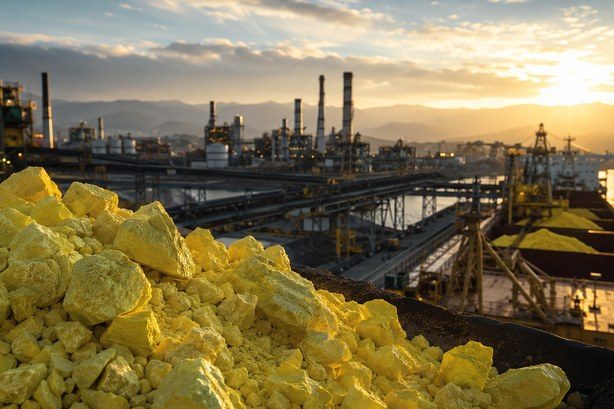
Sulphur sits at the intersection of energy and agriculture, recovered mainly as a by-product of oil refining and gas processing. Global production reached an estimated 84.0 million tonnes in 2025 — but for traders, the real number is delivered availability, not headline production.
Sulphur is often viewed as a secondary input to the fertilizer industry. That description misses the bigger picture.
Sulphur sits at the intersection of two major industrial systems: energy and agriculture.
Most commercial sulphur is not produced because the market specifically wants sulphur. It is recovered as a by-product of oil refining and natural-gas processing. That means sulphur supply depends heavily on refinery throughput, sour crude and gas processing, sulphur-recovery capacity, export infrastructure and the ability to move the material to consuming markets.
At the same time, demand is driven largely by the production of sulphuric acid, phosphate fertilizers, mining and industrial chemicals. This creates a market with an unusual structure:
Oil & Gas → Sulphur Recovery → Sulphur → Sulphuric Acid → Fertilizer / Mining / Chemicals
A disruption at any point in this chain can affect markets much further downstream. For a fuller picture of how execution risk moves through a trade, see our companion piece on why a good deal can still fail before settlement.
A Massive Market With Concentrated Supply
USGS estimates global sulphur production at approximately 84 million tonnes in 2025, compared with 83.9 million tonnes in 2024. Production is expected to increase as new and upgraded refining capacity comes online.
China was the largest producer in 2025 at approximately 19.0 million tonnes, followed by the United States, Russia, Saudi Arabia and the UAE.
The Middle East is particularly important. Saudi Arabia, the UAE, Qatar, Kuwait and Iran together account for a significant share of global production. Much of this supply is connected to maritime routes passing through the Strait of Hormuz. This geographical concentration makes sulphur vulnerable to logistics and geopolitical disruptions. Production capacity alone therefore does not tell the full story.
Where Sulphur Comes From
The main commercial sources are natural-gas processing, oil refining, and metallurgical and mineral-processing activities. In gas processing and refining, hydrogen sulphide (H₂S) is removed from hydrocarbon streams and converted into elemental sulphur, primarily through the Claus process.
The recovered sulphur initially exists in molten form and can then be solidified, granulated or transported in other commercial forms. This creates another potential bottleneck: sulphur requires specialized storage, handling, stockyard, conveyor and loading infrastructure. A refinery may have production capacity, but that does not automatically mean the material can be exported efficiently.
Who Actually Consumes Sulphur?
The largest demand engine is the sulphuric acid and phosphate fertilizer chain. The basic downstream pathway is Sulphur → Sulphuric Acid → Phosphoric Acid → MAP / DAP / TSP.
Sulphuric acid is also essential in hydrometallurgy, including the processing of copper, nickel, uranium and other metals. One area receiving particular attention is HPAL — High-Pressure Acid Leach technology for nickel processing. Expansion of HPAL projects could create additional structural demand for sulphur outside the fertilizer industry.
Morocco Shows How the Market Works
Morocco is one of the clearest examples of the connection between sulphur and downstream industrial demand. The country imported approximately 8.29 million tonnes of sulphur in 2024, making it one of the world's largest sulphur importers.
Its importance comes from its integrated phosphate industry. OCP's phosphate complex at Jorf Lasfar illustrates this relationship particularly well — sulphur procurement is directly linked to the continuity of phosphoric acid and fertilizer production. This is why a sulphur supply disruption can eventually become a fertilizer-cost or fertilizer-availability issue.
The Gulf Is a Critical Trade Hub
The global sulphur trade is built around several major corridors: UAE / Saudi Arabia / Qatar / Oman → Asia, and UAE / Saudi Arabia / Kazakhstan → Morocco.
In 2024, China imported approximately 1.70 million tonnes from the UAE, 1.13 million tonnes from Saudi Arabia, 0.77 million tonnes from Qatar and 0.55 million tonnes from Oman. The UAE exported approximately 5.1 Mt to Morocco, 1.7 Mt to China and 0.9 Mt to Indonesia in 2024. Ports, vessels, freight, insurance and chokepoints are equally important as production volumes.
The question is not simply where sulphur is produced. The question is where it can actually move.
Why the Sulphur Price Is More Complicated Than It Looks
There is no single meaningful "global sulphur price." A sulphur quotation is incomplete without knowing origin, location, quality, product form, delivery basis, freight and contract structure.
The actual delivered cost can be represented as: FOB Sulphur + Freight + Insurance + Port Costs + Handling + Financing + Risk Premium = Delivered Cost. For traders and procurement teams, the more useful question is not "What is the sulphur price?" but "What is the delivered cost of this specific cargo from this origin to this destination?"
The 2026 Lesson: Production Is Not the Same as Availability
The events surrounding the Strait of Hormuz in 2026 highlighted one of the market's most important structural weaknesses: a cargo can physically exist at the origin and still be commercially unavailable to the buyer if the transportation corridor becomes constrained.
Even after a disruption ends, the market may not immediately return to normal. Delayed cargoes, vessel repositioning, insurance repricing, inventory drawdowns and alternative routing can keep physical supply tight after the headline event has passed. Production capacity is not the same as market availability.
What Should Traders Watch Through 2026–2027?
1. Middle Eastern refinery and gas output. Changes in hydrocarbon throughput can directly affect sulphur availability.
2. Strait of Hormuz. Vessel traffic, insurance, war-risk premiums, port congestion and loading schedules remain critical indicators.
3. Morocco's sulphur demand. OCP imports, inventories, sulphur-burning capacity and phosphoric-acid production.
4. China imports. Import volumes, domestic production, fertilizer demand and inventory levels.
5. New refining capacity. New refineries and expansions can add structural sulphur supply.
6. Nickel HPAL projects. Expansion of HPAL capacity could add a significant new source of demand.
7. Pricing benchmarks. Changes in benchmark methodology, contract structures and regional differentials.
For a live, continuously updated view of these variables, see QAA Intelligence's Sulphur market analysis.
The Strategic Insight
Sulphur should not be viewed simply as a fertilizer raw material. It is a by-product commodity positioned between the energy system and the fertilizer system. Its supply begins upstream (Sour Crude + Sour Gas → Refining / Gas Processing → Sulphur Recovery → Available Sulphur) while its major demand is downstream (Sulphur → Sulphuric Acid → Phosphoric Acid → Fertilizer).
This creates a structural imbalance: refiners produce sulphur because they need to remove it from hydrocarbons; fertilizer producers buy sulphur because they need sulphuric acid. Neither side fully controls the other's economics. That is why sulphur can become tight even when oil and gas production remains strong.
For commodity traders, procurement teams and industrial buyers, the most important number is not simply the headline sulphur price. It is the combination of Available Supply + Logistics + Inventory + Financing + Demand + Risk. A cargo is commercially valuable only when the material can be sourced, loaded, financed, transported and delivered to the buyer under workable terms. That is the real sulphur market.
- Sulphur is a by-product commodity positioned between the energy system and the fertilizer system
- Global production reached an estimated 84.0 million tonnes in 2025, concentrated in China, the US, Russia, Saudi Arabia and the UAE
- There is no single "global sulphur price" — delivered cost depends on origin, quality, freight, financing and risk premium
- Production capacity is not the same as market availability, as the 2026 Strait of Hormuz events showed

Amit Tata
CARAVAN Editorial Team, Sales & Analysis Department, Qasr Al Anqaa
Amit Tata covers commodity intelligence for the CARAVAN editorial team.